This is a brief(ish) chronology of the major events in the life of Nichiren Daishonin (1222 to 1282). This has been created as much as my own study aid as anything else. I hope you find it useful.
1222 (Sixteenth day of the second month)
Nichiren Daishonin was, born in the village of Kominato, Awa province (present day Chiba Prefecture), on February 16, 1222. The Daishonin (meaning Great Sage), was born, as he said in Letter from Sado, into a poor family of the chandala class – his father, Mikuni no Taifu and his mother Umegiku made their living by fishing. The chandala are the lowest class in the Indian caste system, and included jailers, butchers, and fishermen, and the Daishonin mentions this to acknowledge his humble origins.
The Daishonin was given the childhood name Zennichi-maro. He lived in the fishing village until the age of twelve
1230
 The Diashonin left Kominato to study at a nearby Tendai temple called Seicho-ji. At the time, temples commonly doubled as schools where people learned literacy.
Zennichi-maro studied Buddhism at Seicho-ji under Dozen-bo, a senior priest of Seicho-ji, and received instruction in Tendai, True Word and Pure Land doctrines. Concerned by the myriad Buddhist schools and contradictions within the Buddhist canon, he became convinced that one sutra existed that must represent the ultimate truth.
He had also been concerned from an early age with the fundamental problem of escaping the sufferings of birth and death, and had come to realise that the answer lay in the Buddha’s enlightenment.
In the temple, Zennichi-maro prayed before a statue of Bodhisattva Space Treasury to become the wisest man in Japan, and his prayer was answered when, as he wrote later, the “living” Bodhisattva Space Treasury bestowed on him “a great jewel” of wisdom. At that moment he awakened to the ultimate reality of life and the universe.
However, to reveal this enlightenment to the people of the Latter Day of the Law, he had to systematise his ideas in relation to the whole of the Buddha’s teachings.
1238
At the age of sixteen, Zennichi-maro resolved to be ordained and took the religious name Zesho-bo Rencho. Some time later he left his teacher Dozen-bo and went to Kamakura to further his studies. There he read the teachings of the Pure Land and Zen schools. Kamakura was a new city with only a limited Buddhist tradition.
1242
After three years of study in Kamakura, Rencho returned to Seicho-ji briefly, and left again the same year for western Japan. This time he went to Mount Hiei, the center of the Tendai school and of Buddhism in general, and later to Mount Koya, the headquarters of the True Word school, and to other important temples in the Kyoto and Nara areas. After some ten years of study at Mount Hiei and elsewhere, he concluded that the true teachings of Buddhism are to be found in the Lotus Sutra. The Lotus represents the heart of Shakyamuni Buddha’s enlightenment; all other sutras are mere expedients leading up to the Lotus.
1253
Rencho returned to Seicho-ji in 1253, with a firm conviction that the true teachings of Buddhism are to be found in the Lotus Sutra.
 Then, early on the morning of the 28th April, he climbed to the top of Mt. Kiyosumi and facing the rising sun chanted Nam Myoho Renge Kyo with the conviction for the first time that this practice alone would enable the people of the Latter Day of the Law to reveal their Buddhahood.
This event marked Nichiren’s embarkation on his lifelong mission to spread the Wonderful Mystic Law. He gave himself the same Nichiren, meaning “Sun Lotus”.
At noon that day, he propounded his doctrine at the temple in the presence of his teacher, Dozen-bo, and other priests and the public. Rubbing his prayer beads, he chanted Nam-myoho-renge-kyo three times. He declared that none of the pre-Lotus Sutra teachings reveals the Buddha’s enlightenment, and could not save the people from the sufferings of birth, old age, sickness and death. Further, he stated that all other teachings were incomplete and inferior and that only Nam-myoho-renge-kyo, the essence of the Lotus Sutra, could lead people of the Latter Day of the Law to enlightenment.
 Everyone was outraged, and they responded angrily. All the audience could understand at the time was the Daishonin’s insistence that all other schools of Buddhism were misguided, including the popular Pure Land school, to which the steward of the region, Tojo Kagenobu, was a devout adherent. The steward demanded the arrest of the Daishonin, but the Daishonin escaped. He briefly visited his parents, converting them to the the new faith before going to Kamakura to spread the Lotus Sutra.
In the eight month of 1253 the Daishonin settled in a small dwelling in Matsubagayatsu, in the southeast of Kamakura. In this dwelling and those of his supporters, The Daishonin began propagating the teachings of the Lotus Sutra. He would also visit temples in the city and debate with chief priests, denouncing Pure Land and Zen schools for their erroneous foundations.

The Daishonin’s actions angered religious leaders, and government officials alike (not least because many were also Pure Land and Zen followers). Opposition became fierce, but the Daishonin continued to win converts.
In was in these early years that the Daishonin gained such major disciples as Shijo Kingo, Toki Jonin, Kudo Yoshitaka and Ikegami Munenaka.
1256
Japan began to suffer a series of calamities, including storms, floods, droughts, earthquakes and epidemics.
1257
A particularly severe earthquake destroyed many temples, government buildings and homes in Kamakura.
1258
The Daishonin travelled to Jisso-ji temple, Iwamoto (present day Shizuoka Prefecture), to consult its copies of the Buddhist canon, and to start assembling incontrovertible proof of the cause of the disasters. During his stay there, he met a thirteen year old acolyte, who became the Daishonin’s disciple. The Daishonin gave the young man the name Hoki-bo (later to become Nikko, the Daishonin’s designated legal successor).
1259 – 1260
Severe famine and plague ravaged the inhabitants of the city.
The most powerful man in the country was Hojo Tokiyori, a former regent of the Kamakura shogunate who had retired to Saimyo-ji, a Zen temple.
16th July – Nichiren Daishonin presented to Tokiyori a treatise entitled On Establishing the Correct Teaching for the Peace of the Land (Jap. Rissho Ankoku Ron). In it, he blames recent upheavals squarely on the people’s slander of the correct teaching, and their reliance on false doctrines.
In particular, the worship of Amida Buddha is cited as a source of slander, and the people are warned that there will be no respite from suffering unless these beliefs are renounced, and the people accept the teachings of the Lotus Sutra.
Excerpts from the Golden Light, Medicine Master, Benevolent Kings and Great Collection sutras describing the various calamities that will befall any nation hostile to the correct teaching are included to support these assertions.
Of the seven calamities mentioned in the Medicine Master Sutra, five had already struck Japan.
Rissho Ankoku Ron goes on to predict that if the authorities persist in turning their backs on the correct teaching, the two remaining calamities, foreign invasion and internal strife, will strike the nation.
The Daishonin was insisting that one should have faith in the ability to attain buddhahood in this lifetime, and transform this world into a pure land as taught by the Lotus Sutra, rather than to resign to suffering and wait for a happy life after death as taught by the Pure Land movement.
It is important to remember that Nichiren Daishonin was not advocating the persecution of the other Buddhist schools or the establishment of a new state religion. The Rissho Ankoku-Ron was a critique of the shogunate’s religious affairs, and was seen by those in power as blasphemous and almost anti-patriotic.
27th August – an angry mob of Pure Land believers burned down Nichiren Shonin’s hut. Fortunately, he had been alerted by his supporters to the threat and escaped. This occasion is known as the Matsubagayatsu Persecution, the first of the four great persecutions which would befall the Daishonin.
1261
The fact that Nichiren Daishonin had escaped the attack at Matsubagayatsu, must have really irritated the authorities, who had probably hoped that the pesky priest would have died in the arson.
In fact, the Daishonin had been invited by a loyal follower, Toki Jonin, to stay in his home outside the city, and continued to teach the Lotus Sutra for several months. Toki Jonin also built a shrine for the Daishonin, and during his stay many people in Shimosa province converted to the Daishonin’s teaching including many Samurai.
During his stay, he debated with a Nembutsu priest, Do Amida Bustu, and thoroughly defeated him before his followers. Angry, and upset, the Nembutsu priest’s followers began persecuting the Daishonin and his followers. When the local Hojo clan rulers (who were adherents of Do Amida Butsu) heard of what had happened, they made plans to deal with Nichiren.
12th May – Bending the historical equivalent of our modern day anti-terrorism laws, Hojo Nagatoki engineered the Daishonin’s arrest on 12th May, and his subsequently being sentenced to exile to the fishing village of Ito, on the Izu peninsula. This event is known as the Izu Exile.
Ito is a rocky area where it was expected that he would starve to death in the wilderness. People were forbidden to provide food or shelter to exiles. It was also no coincidence that the Izu peninsula was a stronghold of the Nembutsu sect.
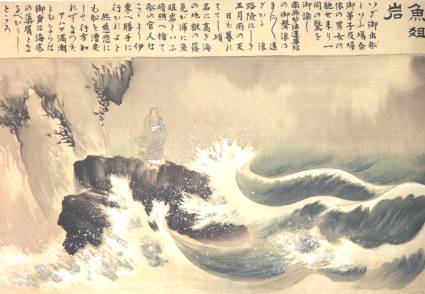
Nichiren was transported by boat and abandoned on the Mana-ita (or “Butcher’s Block”) Reef, off the beach of Kawana, to drown as the tide rose. Sick, and abandoned, he was spotted by an elderly Funamori (fisherman) named Yasaburo. Yasaburo took Nichiren back with him where he and his wife offered to let the Daishonin stay with them.
Afraid for their safety, Nichiren stayed in a nearby cave where Yasaburo and his wife provided him with food for months until Nichiren was sought out by retainers of the Steward of Ito who believed Nichiren could heal his sickness. Nichiren prayed for Ito Sukemitsu, and he recovered. The steward was grateful, and gave Nichiren the statue of Shakyamuni Buddha that the Daishonin later treasured. The Daishonin’s writings during this exile include The Four Debts of Gratitude; The Teaching, Capacity, Time, and Country; and What It Means to Slander the Law.
12th June – The Daishonin went to live on the estate of the steward. Around two weeks later, the Daishonin wrote The Izu Exile.
1263
22nd February – During the Izu Exile, Hojo Nagatoki, who originally exiled the Daishonin, was stricken with an illness and became bedridden, and his father, Hojo Shigetoki died in a state of insanity. Perhaps these events had caused the Kamakura Shogunate to doubt whether they were right to disagree with Nichiren. The Daishonin was pardoned from exile after a year and nine months.
Upon returning to the mainland, Nichiren returned home to Awa province to visit his sick mother, Myoren. He cared for and prayed for his mother, and her life extended by four years.
11th November – The Daishonin’s propagation of True Buddhism continued in Awa Province. The steward of the region, Tojo Kagenobu, a Nembutsu believer waited for a chance to eliminate him. Nichiren Daishonin, accompanied by ten attendants, was on his way to visit one of his believers, Kudo Yoshitaka. Tojo Kagenobu along with a hundred or so soldiers ambushed the Daishonin and his followers in Komatsubara. This event is known as the Komatsubara Persecution.
During the attack, the disciple Kyonin-bo and several others perished. The Daishonin himself suffered a serious head injury and cut to the hand. Another devotee, Kudo Yoshitaka, heard of the attack and rushed to Nichiren’s aid with his own warriors, and a bloody skirmish ensured, resulting in Yoshitaka being mortally wounded.
1268
The Mongol invasion predicted by Nichiren Daishonin appeared a step closer when a letter from the Mongols arrived in Kamakura demanding that Japan acknowledge fealty to Khubilai Khan. The government set about fortifying the coast, and ordered every temple and shrine in the country to offer prayers for the Mongol’s defeat.
Nichiren Daishonin sent letters of remonstration to government officials, including the regent Hojo Tokimune, the chief of military and police affairs Hei no Saemon, and two influential priests in Kamakura, Doryu of the Zen and Ryokan of the True Word Precepts school. These letters restated the case for On Establishing the Correct Teaching – that unless the government embraced the correct teaching, the country would suffer the final two disasters predicted in the sutras. All of the Daishonin’s letters were ignored.
1271

Drought raged, and the government ordered Ryokan, the respected chief priest of Gokuraku-ji temple, to pray for rain. The Daishonin heard of this, and sent a written challenge to Ryokan offering to become his disciple if the latter succeeded in bringing rain, and vice versa. Ryokan accepted, but his prayers did not lead to rain. Kamakura was instead struck by fierce gales. Ryokan refused to become a disciple of the Daishonin, and began plotting against him with Hei no Saemon.
Ryokan and the Zen priest Doryu stirred the wives of the deceased founders of temples founded by the Hojo clan, telling them that the Daishonin had disrespected their deceased husbands. Ultimately these charges against the Daishonin were bought before the government. Thus began what is known as the Tatsunokuchi Persecution.
September 10 – A court hearing was arranged to investigate the trumped up charges. During this, the Daishonin admonished Hei-no Saemon again, warning that the entire country will regret punishing the Votary of the Lotus Sutra.
September 12 – Nichiren’s dwelling was raided by Hei no Saemon, and a gathering of troops. Heo no Saemon’s retainer, Sho-bo, snatched the fifth volume of the Lotus Sutra from the Daishonin’s robes, and struck him in the face with it before throwing it to the ground. The invaders then systematically denigrated the remaining scrolls in the building. The fearless Daishonin admonished them, “How amusing! Look at Hei no Saemon gone mad! You gentlemen have just toppled the pillar of Japan.”
The troops saw Daishonin standing before them unafraid, and realizing they had done something awful, the color drained from their faces. Nichiren Daishonin was arrested and taken to Hojo Nobutoki without investigation.
That night, the Daishonin was to be held in custody at the residence of Lord Honma Rokuro Zaemon Shigetsura at Echi. However, this journey would take the party past Tatsunokuchi, a popular execution ground for serious criminals. As they set out on Wakamiya Avenue, the Daishonin called upon Great Boddhisattva Hachiman at a shrine to the same, admonishing him to carry out his vow to the Buddha to protect the votary of the Lotus Sutra

The Daishonin’s most loyal supporter and samurai, Shijo Kingo, although putting himself at great risk, accompanied the former, holding the reigns of the Diashonin’s horse. Shijo had determined to die with his master in faith, such was his conviction in the Lotu Sutra.
The Daishonin calmly seated himself at the execution site. Shijo Kingo burst into tears believing he was about to lose his mentor and master in faith.
Then, as the executioner drew his sword and positioned himself behind the Daishonin, a shinning object as large as the moon appeared to shoot across the sky from the direction of Enoshima Island, from southeast to northeast. The executioner was stunned, by the burning light and fell to the ground. The warriors there ran for cover, or lay face down, terrified. As a consequence, they were unable to behead the Daishonin, despite the Daishonin encouraging them to be unafraid and to complete their mission before daybreak, when it would be too ugly a task.
This time has profound meaning in Nichiren Diashonin’s life, and is covered the Opening of the Eyes. Nichiren states that he effectively died at Tatsunokuchi, but this was figurative, as he clearly did not die. He was actually referring to discarding the provisional Nichiren, or old identity, and revealing the true identity of Nichiren Daishonin, the Buddha of the Latter Day of the Law who attained Buddhahood in the remote past.
Nichiren saw how shocked and moved were the troops. When he was taken from the beach by the troops to the residence of Homma Rokuro Saemon (deputy constable of the island province of Sado) to be returned to custody, the Daishonin ordered sake for the them. When the soldiers finally left, many of them had decided to discard their Nembutsu beliefs for those of the Daishonin.
October 10 – Nichiren Daishonin, had remained confined for nearly a month at the residence in Echi. Finally, the shogunate ordered that Nichiren be exiled to Sado island. The journey involved crossing Japan, and the Sea of Japan. Eleven days later he arrived in Teradomari (present day Niigata Prefecture), and remained there a further 6 days before favourable weather allowed the crossing to Sado.

So, accompanied by several warrior escorts, the party set sail to Sado island. The Daishonin’s faithful follower Nikko Shonin went with him.
October 28 – The small vessel landed on Sado. On the first day of the eleventh month, the party arrived at Tsukahara. Nichiren’s quarters were a dilapidated shrine called Sammai-do and was in the middle of an area where the corpses of beggers and criminals were abandoned. Exposed to the weather, snow and rain entered through gaping holes in the structure. With nothing more than skins and straw mantles, they managed to survive the first winter.
1272
January 16 – Nichiren debated with several hundred priests of other Buddhist schools. The crowd had gathered in the field surrounding Sammai-do. The Daishonin was victorious in what became known as the Tsukahara Debate. Many of those present converted to his teachings.
February – The Daishonin wrote Opening of the Eyes in which, amongst other things, he identified himself with Bodhisattva Superior Practices, the foremost among the Bodhisattva’s of the earth, the original disciples of the original Buddha who emerged during the Treasure Tower chapter of the Lotus Sutra. Also, Nichiren’s previous prediction of internal strife came true when Hojo Tokisuke, elder brother of the regent, attempted a coupe. Civil feuds broke out in Kyoto and Kamakura between factions of the ruling Hojo clan.
April – Nichiren Daishonin was moved to the residence of the lay priest Ichinosawa, at Ichinosawa on Sado. There he remained for some time.
1274
February – Hojo Tokimune, who did not fully agree with the severe treatment accorded to the Daishonin, ordered an end to the Daishonin’s exile.
March 8 – An official arrived on Sado Island with the Daishonin’s pardon. The Daishonin left Ichinosawa on the 13th and returned to Kamakura.
March 26 – Nichiren arrived back at Kamakura.
April 8 – Nichiren Daishonin was ordered to appear before a military tribunal. Again, Hei no Saemon was the presiding official, but clearly this time he has more receptive to what the Daishonin had to say.
When asked about the possibility of Mongol invasion, the Daishonin confirmed that an invasion was still likely within the year. He added that the government should not ask the True Word priests to pray for the destruction of the Mongols, since their prayers would only aggravate the situation.
An old Chinese text says that, if a sage warns his sovereign three times and still is not heeded, he should leave the country. Nichiren Daishonin had three times remonstrated with the rulers, predicting crises – once when he presented On Establishing the Correct Teaching, again at the time of his arrest and near execution at Tatsunokuchi, and once more on his return from Sado.
May 12 – Convinced that the government would never heed his warnings, Nichiren Daishonin left Kamakura. He settled in a small dwelling at the foot of Mount Minobu in the province of Kai (present-day Yamanashi Prefecture). His life in remote Minobu was not easy. His followers sent him money, food, and clothing, and occasionally visited to receive instruction.
Nearly half of the Daishonin’s extant works date from this period. His lectures on the Lotus Sutra during this period were compiled by Nikko Shonin and are known as The Record of the Orally Transmitted Teachings.
October – The Mongols launched the attack that was earlier predicted. Daishonin expressed his bitter disappointment that his advice had been ignored by the government. He was convinced that the nation could have been spared much suffering.
During the following period, Nikko Shonin was successful in converted priests and many lay people of Atsuhara Village, in Fuji District of Suruga Province.
1279
April – Gyochi, a lay priest and a member of the ruling Hojoclan who acted as the deputy chief priest of the temple, was angry at the Daishonin’s actions. He managed to persuade samurai Ota Chikamasa and Nagasaki Tokitsuna in addition to other followers of Nichiren to renounce their faith and join forces with him in intimidating Nichiren’s believers among the peasantry.
Eventually, the priests succeeded in having warriors arrest the unarmed farmers of the convert group on false charges of thievery.
Subsequently twenty of the innocent farmers were arrested and tortured and, tragically, three brothers Jinshiro, Yagoro, and Yarokuro were beheaded. The incident, known as the Atsuhara Persecution, was a grave cause for sadness. Earlier persecutions had been aimed firmly at the Daishonin, but this time it was his followers who were suffer at the hands of corrupt officials.

October 12 – Nearly twenty-seven years after he had first chanted Nam-myoho-renge-kyo, the Daishonin was inspired to inscribe the Dai-Gohonzon, the great mandala, later transferred to Nikko, which he intended as the object of devotion for the enlightenment of humankind
1282
Now in his sixty-first year, the Daishonin was in failing health. Feeling that death was near, he designated Nikko Shonin as his legitimate successor. Disciples and, the regent, followers urged him to visit a hot spring in Hitachi to improve his health.
September 8 – The Daishonin left Minobu for Hitachi. When he reached the residence of Ikegami Munenaka in what is today part of the city of Tokyo, he found he was too ill to continue. Many of his followers, hearing of his arrival, gathered at Ikegami to see him.
October 13 – In the morning, surrounded by disciples and lay believers reverently chanting Nam-myoho-renge-kyo, Nichiren Daishonin peacefully passed away.